











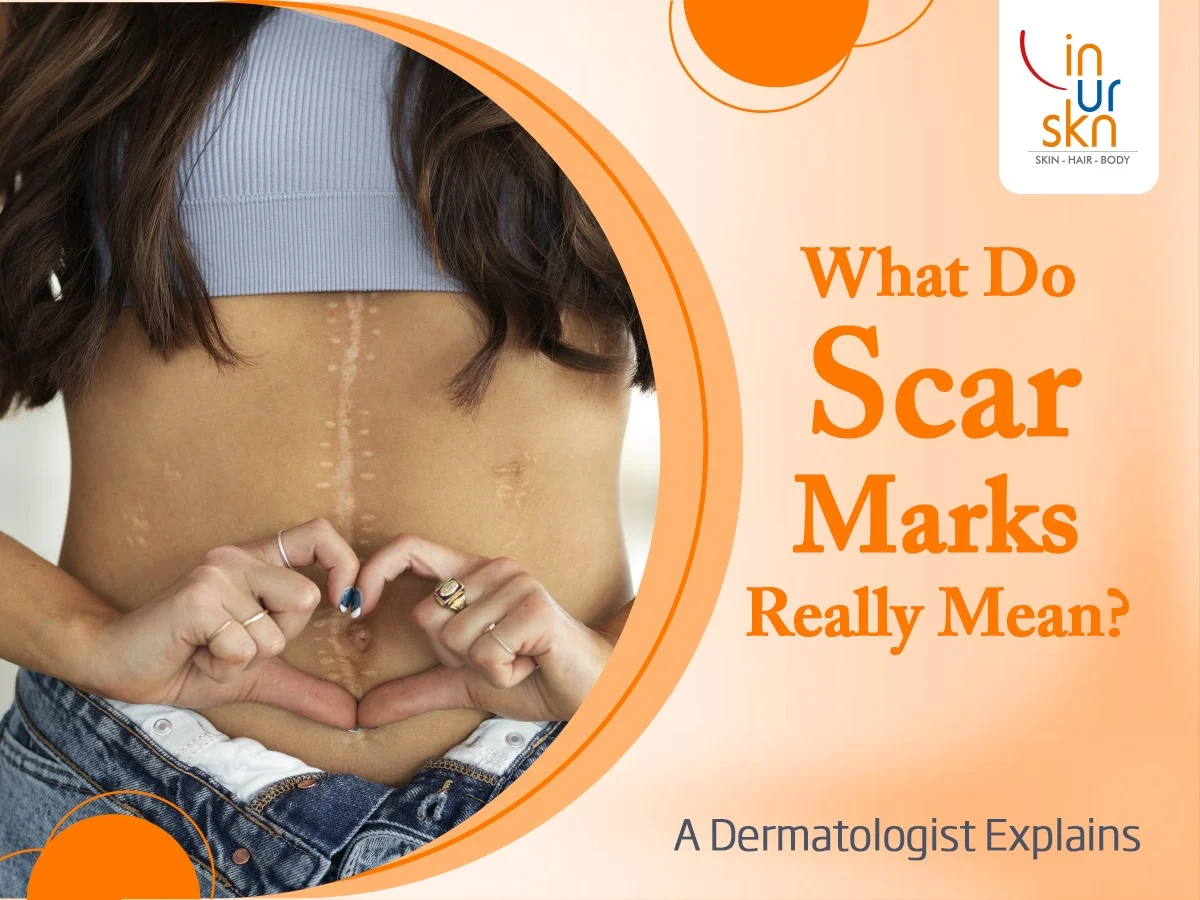
If you’ve noticed a dark spot, red patch, indentation or raised area left behind after acne or an injury, you may be wondering what are scar marks — and whether every mark on the skin actually counts as a scar. The answer is: not necessarily. Some marks are temporary changes in skin colour, while others reflect a genuine change in the skin’s structure, and the two don’t always need the same approach.
When people search “scar marks means“, they’re usually trying to understand what a visible mark says about how their skin healed — a true scar forms when the normal skin structure is altered during healing. This guide covers the scar mark meaning, the different types of acne scars, what an atrophic scar is, how acne scar treatment is chosen, and how to lower the odds of new scars forming.
Is Every Mark Really a Scar?
Not every mark left after acne is a structural scar. The most useful starting point is asking whether the change is mainly about colour, texture, depth or raised tissue.
| Skin Change | What It May Mean | Always a Scar? |
| Dark flat mark | Post-inflammatory hyperpigmentation | No |
| Red or pink flat mark | Post-inflammatory erythema | No |
| Atrophic scar | Loss of supporting tissue | Yes |
| Hypertrophic scar | Excess scar tissue | Yes |
| Keloid | Excess scar tissue beyond the injury | Yes |
The American Academy of Dermatology notes that flat dark spots after acne are generally not classed as acne scars, while depressed and raised changes represent true structural scarring (AAD – Acne Scars).
Identifying the type of mark matters more than labelling everything an “acne scar” — a treatment designed for pigmentation won’t correct a deep indentation, and a procedure meant for a depressed scar isn’t necessarily right for a simple dark spot. If the skin stays smooth and only the colour has shifted, it’s more likely pigmentation or redness than a structural scar; colour describes what’s visible on the surface, while texture reveals whether the underlying structure has actually changed. That distinction sits at the heart of scar mark meaning (AAD – Acne Scars Treatment).
Why Do Acne Scars Develop?
Acne scars become more likely when inflammation reaches deeper layers of the skin. Deep inflammatory acne — particularly nodules and cysts — carries a greater association with scarring, and picking, squeezing or scratching adds further inflammation and tissue injury (AAD – Causes of Acne Scars).
Deeper inflammation can damage the skin’s supporting structures, which is why more severe acne carries a higher potential for lasting change — though severity alone doesn’t determine who scars. Repeatedly touching or squeezing an active spot adds mechanical trauma on top of that, so keeping hands off active acne is one of the simplest ways to lower the risk.
Types of Atrophic and Raised Acne Scars
An atrophic scar sits below the surrounding skin surface, and most acne scars fall into this category, generally grouped into three patterns (PubMed – Acne Scarring Classification):
- Ice-pick scars: narrow, deep depressions that can look like small, sharply defined openings.
- Boxcar scars: broader depressions with relatively defined edges, often noticeable on the cheeks.
- Rolling scars: wider, sloping depressions that create a wavy texture as light crosses the skin.
Not every scar is depressed. Hypertrophic scars are raised but generally stay within the original wound’s boundaries, while keloids extend beyond it and may return after treatment — which is why raised scarring needs specialist assessment (AAD – Acne Scar Treatment).
Appearance also depends on individual factors: skin tone (some procedures carry a pigmentation risk in susceptible skin) and location (depressed facial scars often look more visible under directional lighting, as small changes in depth cast shadows).
How InUrSkn Assesses Scar Marks
A proper assessment looks at more than colour — whether the skin is flat, depressed, tethered, raised, firm, discoloured or uneven all matter. At InUrSkn, this starts with understanding the concern, not assuming every post-acne mark is a scar:
- Skin history: when the mark appeared, whether it followed acne or injury, and how it has changed.
- Clinical examination: assessing pigmentation, depression, raised tissue, and texture.
- Scar-type identification: distinguishing pigmentation from atrophic or raised scarring.
- Treatment discussion: options discussed according to scar type and skin characteristics.
The AAD notes that acne-scar treatment should be tailored to scar type, skin tone, age, budget and treatment goals (AAD – Acne Scars: Consultation and Treatment).
Acne Scar Treatment Options
There’s no single acne scar treatment that works for everyone — the right choice depends on scar type, skin characteristics, severity, active acne and the desired outcome.
- Microneedling uses controlled micro-injuries to trigger the skin’s wound-healing response. A 2026 review of 11 studies and 713 participants found it broadly comparable to chemical peels for atrophic scars, with no consistent evidence that either is superior (PubMed).
- Fractional laser creates controlled thermal injury to encourage remodelling. A 2026 meta-analysis comparing it with needling-based approaches found substantial variation between studies, reinforcing that treatment should be individualised rather than a single “best” procedure (PubMed).
- Chemical peels suit selected presentations, with strength and type chosen around the patient’s skin and concern.
- Subcision may help selected depressed scars where fibrous attachments contribute to the indentation, often for rolling or tethered scars.
- Dermal fillers can add volume beneath selected depressed scars, though results are typically temporary.
Some people have more than one scar type at once, and a single treatment may not address every component involved. A 2026 network meta-analysis assessing lasers, microneedling, radiofrequency microneedling, peels, subcision, fillers and combinations for moderate-to-severe atrophic scarring highlighted just how individualised treatment selection has become (PubMed).
Do You Know?
Not every dark acne mark is a scar. A flat dark mark following acne can be post-inflammatory hyperpigmentation rather than structural scarring.
Source: AAD – Acne Scars Treatment
Scar treatment can take time. Many professional scar treatments work through gradual skin remodelling rather than an immediate result, and multiple sessions may be needed depending on the approach.
Source: AAD – Acne Scar Treatment and Aftercare
Daily Habits That Help Prevent New Scars
Existing structural scars usually need professional treatment, but everyday habits can lower the risk of new marks:
- Control active acne — treating it reduces ongoing inflammation and further scarring risk.
- Avoid picking, squeezing or scratching active spots.
- Use daily sun protection to limit worsening pigmentation.
- Keep skincare gentle and skip unnecessary scrubbing.
- Follow aftercare instructions closely after any procedure.
- Set realistic expectations — treatment can improve appearance, but complete removal isn’t guaranteed.
Also Read
- Best Ointment for White Patches on Skin & Back
- A Clinical Look at Permanent Hair Removal Cost and Long-Term Skin Benefits
Frequently Asked Questions
Q1. What are scar marks?
They’re visible changes that remain after skin damage or inflammation heals.
Q2. Are all acne marks scars?
No. Flat dark or red marks may be colour changes rather than structural scars.
Q3. What is an atrophic scar?
A depressed scar that sits below the surrounding skin.
Q4. What are the main types of atrophic acne scars?
Ice-pick, boxcar, and rolling scars.
Q5. Can acne cause permanent scars?
Yes, particularly when inflammation damages deeper skin structures.
Q6. Can picking cause acne scars?
Yes — picking can increase inflammation and skin injury.
Q7. What is the best acne scar treatment?
There’s no single best treatment; it depends on the scar type and individual skin.
Q8. Do acne scars disappear naturally?
They may become less noticeable over time, but structural scars can persist.
Conclusion: Understanding Scar Marks Is the First Step
Understanding scar marks means more than spotting a dark or uneven patch on the skin. A post-acne mark may be pigmentation, redness or genuine structural scarring — an atrophic scar can show up as an ice-pick, boxcar or rolling depression, while hypertrophic scars and keloids need a different approach altogether.
For anyone considering acne scar treatment, the first and most useful step is identifying what type of skin change is actually present. Current evidence supports several treatment options, but recent research also shows outcomes vary between procedures and patients — so there’s rarely one universal answer.
If a mark is persistent, deeply depressed, raised, painful, changing or affecting your confidence, a qualified dermatologist can help identify its cause and talk through appropriate options. InUrSkn’s approach starts with assessment, education and personalised treatment planning, rather than assuming every post-acne mark is the same.


 Call us
 Book Appointment
 Enquire
 Location


